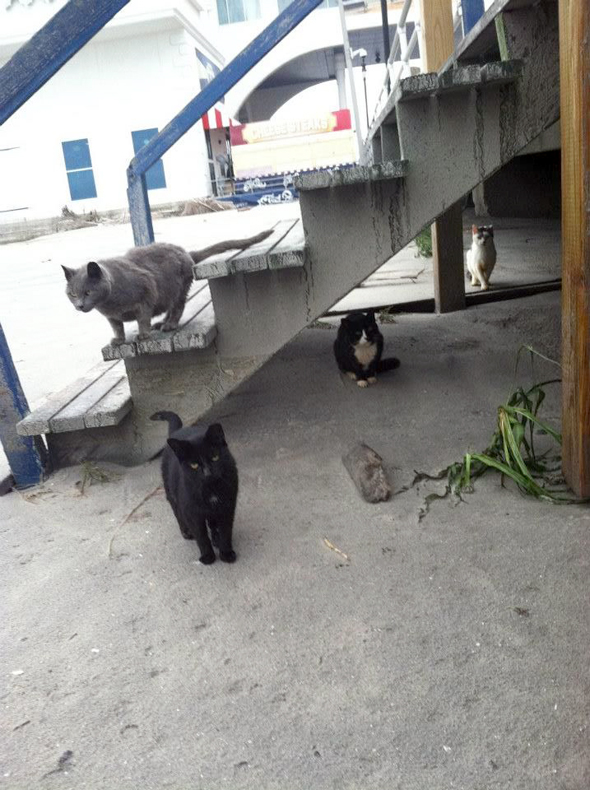
Readers who follow online discussions about free-roaming cats and TNR will likely recognize Walter Lamb’s name. His comments stand out in such forums for their well-articulated, insightful, and refreshingly rational quality. Walter brings a unique perspective to these discussions, too—a bird watcher who’s used TNR to manage his neighborhood’s stray, abandoned, and feral cats.
Walter and I have communicated by e-mail for nearly 18 months now, sharing research notes and offering commentary on various news stories and research studies. In June, he contacted me with an intriguing idea for a Q&A blog post—which, I’m pleased to say, finally made it to the top of my to-do list.
Thank you, Walter, for your patience and your ongoing, thoughtful correspondence!
WL: As you know from our previous communications, I am an avid bird watcher who also used a sterilize and return approach to successfully reduce the number of homeless cats in my neighborhood from about 20 unsterilized (and reproducing) cats down to 2 remaining sterilized cats. I have been very disappointed that some wildlife conservation organizations, and many of my bird watching peers, have taken a dogmatic and moralistic approach to universally vilifying non-lethal methods of control rather than objectively analyzing all of the available science to devise pragmatic policies that can achieve the best results for wildlife in various settings.
However, I also believe that many cat advocacy groups are similarly guilty of focusing too much on talking points at the expense of objectively evaluating how they can maximize the impact of their efforts not just for cats, but for our native wildlife as well. While I understand that your blog is dedicated to protecting cats, you have always demonstrated an open mind and a willingness to consider differing perspectives. I’m hoping that you will publish the four points outlined below on your site along with your responses to them.
Population Reduction
My neighborhood project was successful because our local mentor was very blunt about the need to aggressively trap all of the unfixed cats. She didn’t sugarcoat anything or lead us to believe that just catching one or two cats was a noble effort in its own right.
I find it troubling that an organization like Alley Cat Allies doesn’t even mention population reduction in their mission statement, vision statement, or list of core values. One gets the sense from their web site that merely choosing a non-lethal approach to the problem is sufficient. I’m interested in your perspective as to why measurable and documented population reduction doesn’t seem to be more ingrained in the culture of organizations like Alley Cat Allies (or if you think it is and I’ve just missed it).
PW: Obviously, I can’t speak for Alley Cat Allies—let me see if I can address your concern from my own perspective. I am, as I think you know, a proponent of the kind of intensive sterilization effort you and your neighbors achieved. That said, I would argue that sterilizing just one or two is better than the alternative. From a population-control perspective, it’s unlikely to make a difference (unless the colony is no bigger than three or four cats), but then again, neither is having animal control haul them away to be killed. And, as you know, this is typically how such roundups go: cats are trapped only until complaints subside. At which time the remaining cats—very likely unsterilized—will continue reproducing.
And I think there’s another factor that we shouldn’t overlook or discount: people are much more likely to participate in, and support, life-saving efforts. While I agree that it’s critical to get as many cats as possible sterilized—and that this message is conveyed to anybody involved in TNR—I worry that an all-or-nothing approach will only serve to hamper any efforts to get started. In which case, the only option will be taxpayer-funded roundups—and we know how well that’s been working.
“No More Homeless Cats” vs. Homeless Cats as Critical for Ecological Balance
WL: This strikes me as an example of conflicting talking points. On the one hand, the Best Friends’ slogan seems to highlight a goal of getting cats out of the environment and into loving homes. On the other hand, defending cats’ place in the outdoors as critical for ecological balance, namely in the form of rodent control, seems to run counter to that goal.
I realize that there are examples in which the removal of cats did have unintended impacts on island ecosystems, but I’m not sure that translates to other ecosystems, especially on the mainland. I worry that this sends the wrong message to colony managers who might actually be able to achieve zero population but are given the impression that zero population is not actually a desirable goal. What is your take on this seeming contradiction?
PW: Just as I can’t speak for Alley Cat Allies, I can’t speak for Best Friends.* But, again, I’m happy to share my own thoughts. As you know, many outdoor cats are simply not adoption candidates. Many of us—including the folks at Alley Cat Allies, Best Friends, and myself—think that a fearful or unsocialized temperament is not sufficient cause for lethal control. One of the few remaining options for these cats, then, is as “working cats”—in barns, warehouses, or other environments where rodent control is desired.
Now, some argue that cats don’t actually keep down rodent numbers, and I have no first-hand experience with this myself. But as you know, cats have served this function for thousands of years now. (I’ve heard anecdotally of instances in which business owners complained of the rats and mice following the removal of cats from a particular area.)
To your more general point about cats and the environment, though—I don’t know that we’ll ever reduce the population of outdoor cats to zero across a large area (for a number of reasons). But I also don’t know that any colony managers are reducing their efforts if and when they have the opportunity to sterilize/adopt/re-home their way to zero population for a particular colony.
Feeding vs. Sterilizing
WL: It is always interesting to me that the most controversial aspect of TNR isn’t even represented in the acronym itself. I think the very different actions of sterilizing a cat and feeding a cat should be thought of separately, even if both are considered important from an animal welfare perspective. Telling someone that they shouldn’t attempt to trap and sterilize a group of cats unless they are also willing and able to feed and care for them indefinitely seems destined to suppress overall sterilization rates.
I won’t get into a detailed discussion of the pros and cons of feeding as I know you have delved into those issues in depth on your blog. What I will say is that I think that both the pros and cons of feeding are getting lost in the polarization of the discussion. I find the defense of feeding stations to be far less solid scientifically than the defense of sterilize and return itself. I was very interested in your quote of Animal People editor Merritt Clifton articulating why he opposes feeding and I hope that could be the grounds for a more thoughtful discussion of the pros and cons of various feeding practices in different settings. [Full disclosure, we fed some of our neighborhood cats on our back porch, but only after we had achieved a virtual 100 percent trap rate.]
PW: You’re absolutely right about the controversy surrounding feeding. And I agree that making sterilization efforts contingent upon a long-term caretaker commitment is counterproductive.
I know some people who, as Merritt recommends, feed only for the purposes of trapping and sterilizing. Once the cats are returned, they’re on their own. While I understand the arguments for such an approach, I think it overlooks or ignores some key advantages of ongoing feeding:
1. Regular feeding allows for ongoing monitoring for “new arrivals.” I’ve seen this first-hand, when I started feeding only one or two cats on my patio—only to have their siblings turn up soon thereafter, along with three kittens. I was able to trap and sterilize all but one adult. (I haven’t seen this cat in many months.) The kittens were all adopted. Without the daily handouts, these cats would have remained essentially invisible—and would have contributed further to the neighborhood’s population. One of my own (indoor-only) cats is another case study—had I not been feeding a small colony nearby, I never would have found, sterilized, and, ultimately, adopted him.
2. For some caretakers, regular feeding provides the opportunity to bond with the cats (even if they’ll never be able to actually touch them, as is often the case). While this factor is often dismissed by TNR opponents, I think it’s incredibly important to the ongoing effort to bring down the population of stray, abandoned, and feral cats. I think for many people, it’s this bond that keeps them involved with TNR. Take away the feeding, and you’re likely to deter such participation—and, as I think you’ll agree, we need “all hands on deck.”
[One common objection to feeding is that the food attracts wildlife that might carry rabies. In some contexts, it’s a very valid point. But again, on the whole, I think the benefits outweigh the risks. In areas where rabies among cats is more common—here in Arizona, it’s virtually unheard of—vaccinations are an integral part of most TNR programs. So the feeding and monitoring leads not only to sterilization, but also vaccination—which then serves as a kind of protective barrier between rabies in raccoons, for example, and humans.]
Adoption
WL: I am aware of the herculean efforts of many cat advocates to tame and adopt the cats that they trap. Adoption to indoor only homes is the same as permanent removal from a wildlife conservation perspective and is one the best ways to achieve immediate population decline. However, when reading news coverage from different areas across the country, I very often hear the blanket statement that “these cats aren’t adoptable.” I realize that is indeed true of many feral cats, even those who may seem tame in the presence of their caretakers. However, I worry that in some cases the assumption is made that the cats aren’t adoptable when that may not be the case.
Our neighborhood cats certainly seemed unadoptable when we first trapped them. It took a good deal of time and effort, following the advice of our local mentor, before we discovered that these cats were actually semi-domesticated and adoptable. I’m wondering if this isn’t another case of one overly simplistic talking point (i.e., “these cats should be put in homes instead of returned to the outdoors”) being countered by another overly simplistic talking point (i.e., “these cats aren’t adoptable”) instead of trusting new volunteers to understand a deeper level of complexity (i.e., whether cats can be adopted depends on many variables, such as availability of homes, resources for fostering the cats, how feral the cats have become, etc.). I’d be curious to know whether you think more can be done to encourage greater rates of adoption of trapped and sterilized cats prior to return to the outdoors.
PW: I suppose the message that “these cats aren’t adoptable” is intended not so much for the folks willing to put in the time (as you and your neighbors have done), but for the various stakeholders who so often misunderstand and/or misrepresent the fate of cats rounded up. It’s not uncommon for a shelter to have a live-release rate of 50 percent or less for cats. (Some, like Polk County (FL) Animal Control, kill more than 90 percent of cats brought in.) If the cats aren’t very adoptable from the moment they arrive, they’ll almost certainly be killed. And, when these cats are taking up precious cage space, it means more of the adoptable cats will be killed as well.
In my experience, it’s not so uncommon for colony cats to warm up to caregivers—charming their way into homes the way a couple of mine did. But it takes more time than most rescues/fosters would be willing to give. And unless they’re kittens, these cats don’t seem to do well indoors, anyhow. That said, there will certainly be exceptions. And I think adoption is a valuable aspect of TNR—better lives for the cats and some happy endings for their caretakers, too. And, fewer of them outdoors, of course.
• • •
When Walter first contacted me with his Q&A proposal, it was, he explained, with the “hope that we can set a better example of how to have a civil dialogue on this important topic than what you and I have encountered elsewhere.”
Indeed! Thank you, Walter, for the invitation.
* Full disclosure: I support Alley Cat Allies and Best Friends—financially (at a very modest level) and in terms of their overall missions—and I communicate with various individuals in both organizations on a regular basis. I’m also incredibly grateful for the support they’ve shown me (e.g., profiles in their publications, the opportunity to present at the recent No More Homeless Pets Conference, etc.).