TNR In Prime Time

“We need to explode the concept of what a cat guy looks like, what a cat girl looks like,” argues Jackson Galaxy in his book, Cat Daddy: What the World’s Most Incorrigible Cat Taught Me About Life, Love, and Coming Clean. “We need a country literally full of cat guys and cat girls, bikers, politicians, clergy, and everyone in between, in order to keep millions from dying without homes.”

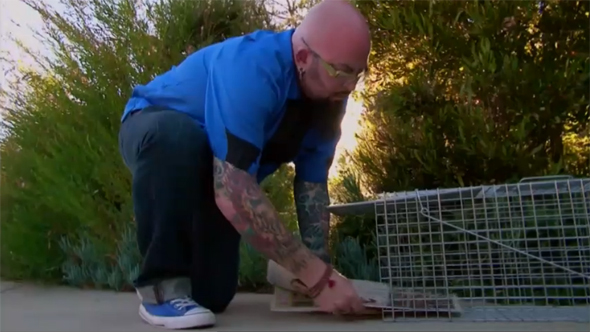
In Jackson’s case, the look includes a shaved head, sculpted facial hair, enormous earrings, and loads of tattoos. On last week’s episode of his wildly successful show, My Cat From Hell (which you can watch online), he revealed a new accessory: a humane trap. Read more

Prince George’s County, Maryland

“Bird lovers have just derailed a plan to save some alley cats from death at the hands of animal control,” writes Bruce Leshan in a WUSA-9 TV story that aired Tuesday. “When Prince George’s County Council woman Mary Lehman proposed to order animal control to release” TNR cats, “she ran into a storm of criticism at a council public hearing.” [1]

As Lehman pointed out, “This is not trail-blazing legislation. Fairfax County, Baltimore City, and Washington, DC, all have programs.”

So what’s the hold-up in Prince George’s County? Mostly the American Bird Conservancy, it seems.

“The American Bird Conservancy, which opposes ‘trap, neuter, and return,’ says what you are really doing is releasing predatory, ownerless cats back into the wild to kill again.” [1]

Presumably, ABC will be leading the charge when Lehman brings her bill up again in the fall, which she’s promised to do. Perhaps they can then explain to the Prince George’s County Council—and everybody else—the rationale for their position. Where’s the science to support the numerous claims they make to the media? Read more

Animal Wise Radio (July 22)

Did you catch this week’s Animal Wise Radio show? Hosts Mike Fry and Beth Nelson invited me on to discuss the story of 76-year-old Joy Mattice, who’s currently facing misdemeanor charges for feeding cats in Minneapolis, as well as the Brevard County (FL) Commission’s decision to place a moratorium on new TNR colonies.

If you missed it, you can check the complete show in podcast format. An MP3 file (11.5 MB) of our conversation (approximately 23 minutes) is available here.

This Sunday—Tune in Once Again to Animal Wise Radio!

Tune in tomorrow to Animal Wise Radio, when I’ll be on with hosts Mike Fry and Beth Nelson. Though it’s only been a couple of weeks, there’s a lot to talk about! The recent move by the Brevard County (FL) Commission to place a moratorium on new TNR colonies, for example. And the story of 76-year-old Joy Mattice, who’s currently facing misdemeanor charges for feeding stray cats in Minneapolis.

As always, you can listen online—the show is live 12:00–2:00 CDT. And while you’re at it, please show your support by “Liking” their Facebook page. (And, while you’re doing that, head on over to the Animal Ark Facebook page as well…)

Rabies: Some Much-Needed Perspective

Seven minutes and 35 seconds. That’s how long Robert Siegel, co-host of NPR’s All Things Considered, spoke with Bill Wasik and Monica Murphy about their new book, Rabid: A Cultural History of the World’s Most Diabolical Virus.

Cats weren’t mentioned even once.

Was this a massive oversight? A coup perpetrated by the Powerful Cat Lobby, perhaps?

Hardly. “Veterinarians spend a lot of time thinking about rabies, even though in this country, we hardly ever see it,” explained Murphy, a veterinarian. (Wasik, her husband, is a journalist.)

The scaremongerers over at the American Bird Conservancy and The Wildlife Society must be downright distraught at the thought of the American public being better informed on the subject. Indeed, an excerpt from Rabid describes some of the underlying myths and cultural baggage these folks routinely attempt to leverage in their witch-hunt against free-roaming cats.

“As the lone visible instance of animal-to-human infection, rabies has always shaded into something more supernatural: into bestial metamorphoses, into monstrous hybridities. Even during the twentieth century, after Pasteur’s invention of a rabies vaccine provided a near-foolproof means of preventing its fatality in humans, our dark fascination with rabies seemed only to swell. The vaccine itself became as mythologized as the bug, such that even today many Americans believe that treatment requires some twenty (or is it thirty?) shots, delivered with a foot-long syringe into the stomach. (In fact, today’s vaccine entails four shots, and not particularly deep in the arm.)

It’s almost as if the very anachronism of rabies, to the Western mind, has rendered it even more intriguing to us. Like the vampire, rabies carries with it the musty whiff of a centuries-old terror—even as it still terrifies us in the present day.”

Not exactly your typical summertime reading, maybe, but this one’s going on my list. I wonder if I can get signed copies for ABC’s Darin Schroeder and TWS’s Michael Hutchins

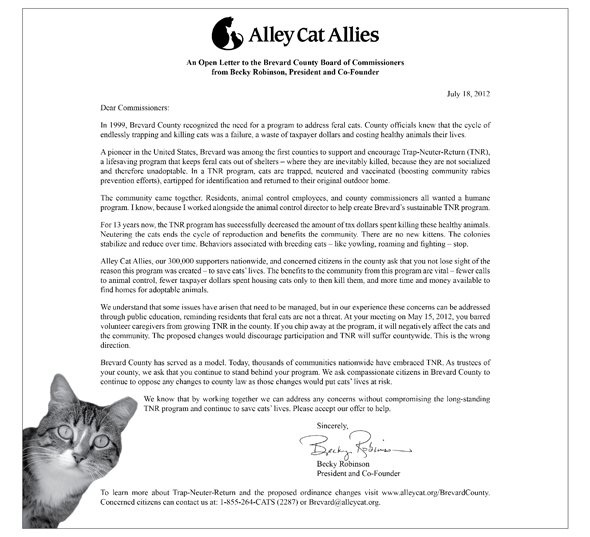
Brevard County, Florida, Threatens Further Restrictions for TNR

For 50 years now, people have flocked to Brevard County, Florida—home of the Kennedy Space Center—to witness some of the most wildly ambitious endeavors ever imagined. It was a similar pioneering spirit that led the community to adopt TNR in 1999, well ahead of so many others.

Today, a year after the final Space Shuttle flight, the future of manned spaceflight remains very much an open question. Sadly, the future of TNR in Brevard County is also in doubt.

On June 9th, Florida Today reported that “the Brevard County Commission slapped a moratorium on new colonies in residential areas” during its May board meeting. Now, “officials are researching changes to existing rules.” [1] Read more

You Make a Statement, RCTees Will Make a Donation

Three reasons to sign up for Jackson Galaxy’s e-mail list:

  1. You’ll be supporting Jackson, a tireless advocate for all cats—including those living on the streets. (In May, he took time out of his crazy schedule to help raise money for Spay/Neuter Hotline’s TNR program here in Arizona.)
  2. You’ll learn how to better understand your cats’ behaviors—and how to change them—from the star of Animal Planet’s My Cat From Hell. Happier cats, happier guardians—you get the idea.
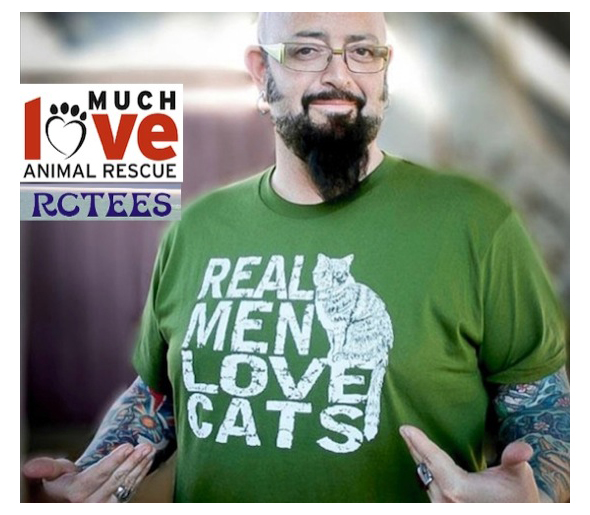
  3. You’ll learn about deals like this one. For all of July, the folks at RCTees are donating $2.00 from every purchase of their Real Men Love Cats design to Much Love Animal Rescue. The shirt—a favorite of Jackson’s—is available in men’s and women’s sizes, short- and long-sleeve, and a variety of colors.

You’re welcome.

Arkansas Game and Fish Declines Offers of Assistance with Feral Cats

When I wrote recently about the Arkansas Game and Fish Commission’s decision to begin trapping cats at the Barnett Access on the Little Red River, I suggested that AGFC fisheries biologist Tom Bly had “been drinking TNR opponents’ Kool-Aid.”

Bingo!

That same day, I sent an e-mail to the AGFC director/deputy directors and commissioners asking for an explanation for the roundup. AGFC Director Loren Hitchcock responded promptly, forwarding my e-mail to Bly, who in turn wrote:

“My information came from the Spring 2011 issue of The Wildlife Professional. This is the magazine of the “The Wildlife Society” and includes peer reviewed and published articles on wildlife management and dealing with feral cat issues. The link to the publication is http://issuu.com/the-wildlife-professional/docs/feralcats.

As you will notice nearly one third of the publication is concerned with wildlife depredation by feral cats and public health related issues.”

Kool-Aid? Check. Read more

Endangered In the Florida Keys: Journalism

The witch-hunt against free-roaming cats—promoted by USFWS and others—is doing nothing to protect the threatened and endangered species in the Keys (and elsewhere). Neither is the sloppy reporting that allows the agency to mislead policymakers and the general public.


Monday’s Tampa Bay Times reported that a captive breeding program aimed at saving the endangered Key Largo woodrat from extinction has been shut down.

“At first the breeding program seemed to be a big success. At Lowry Park and, later, Disney’s Animal Kingdom, the endangered rats bred like, well, rats. But then the project ran into big problems, demonstrating why captive breeding is a tricky strategy that’s used only as a last resort, said Larry Williams, South Florida field supervisor for the Fish and Wildlife Service.” [1]

In fact, reporter Craig Pittman provides no evidence that the Key Largo woodrats were ever “breeding like rats.” Not even in the wild. Indeed, as he points out, “they… tend to be solitary. The males and females only get together when the female is ready to breed.” [1]

In any case, the population in the Keys—now limited to Crocodile Lake National Wildlife Refuge and Dagny Johnson Key Largo Hammocks Botanical State Park—continued, by all accounts, to decline. “Wildlife biologists,” writes Pittman, “didn’t have to look far for the reason.”

“Next to the parks is the Ocean Reef Club, a gated community that boasts some of South Florida’s wealthiest residents—as well as the state’s largest feral cat population. Ocean Reef’s homeowners spend thousands of dollars a year on a program that feeds and cares for the stray cats that wander the back alleys—and, according to biologists—occasionally gobble up endangered rats.” [1]

It’s true that biologists didn’t have to look far. “The primary threat to the Key Largo woodrat,” explains a 1999 USFWS report (which, admittedly, includes feral cats among the “other threats associated with human encroachment”), “is habitat loss and fragmentation caused by increasing urbanization.” [2]

But Pittman’s so busy trying to pin the Key Largo woodrat’s fate on the one-percenters that he fails (conveniently!) to mention that the Ocean Reef cats are also sterilized. Read more

Feral Cat Nerd

As co-host Beth Nelson was introducing the second hour of yesterday’s Animal Wise Radio show, she referred to me as a “feral cat nerd.” Beth tells me she meant it as a compliment, and that’s exactly how I’m taking it. Besides, as I told her and Mike Fry off the air, I’ve been called far worse by some folks familiar with my work.

If you missed it, you can check the complete show in podcast format). An MP3 file (11.3 MB) of our conversation (approximately 23 minutes) is available here.

Tune In to Animal Wise Radio Sunday!

Tune in tomorrow to Animal Wise Radio, when I’ll be catching up with hosts Mike Fry and Beth Nelson. (It’s been more than seven months!) Among the topics up for discussion: toxoplasmosis, rabies, and typhus (oh, my!).

Listen online—and while you’re at it, why not show your support by “Liking” their Facebook page.

Pompano Beach: Bailing the Ocean with a Thimble

David Aycock says he loves cats. Which is why he sends them—as many as he can—to the Broward County (Florida) animal shelters to be killed.

Having trouble following Aycock’s “logic”? Me too.

So are the folks at Broward County Animal Care and Adoption, according to a story in Friday’s South Florida Sun Sentinel.

“Broward County two months ago officially embraced a no-kill goal for its shelters, a move Miami-Dade County made just last week. But Broward officials and cat lovers concede the goal won’t be met as long as the shelters continue to fill up with feral cats, and for now, the cats continue to be put down.” [1]

Which is where Aycock, chief animal control officer for Pompano Beach, comes in. “While [Broward officials] try to achieve a no-kill shelter, he’s continuing his aggressive approach, sending scores of feral cats from Pompano Beach to their shelters.” [1] Read more

Arkansas Game and Fish Commission Targets Feral Cats

“The Barnett Access on the Little Red River is being overrun with feral cats,” reported last Tuesday’s edition of The Sun-Times, the local paper in Heber Springs, Arkansas. “Due to the interaction between the public and feral cats, and the risk to human health, the Arkansas Game and Fish Commission is going to begin a trapping effort in July to remove the cats.” [1]

Interaction between the public and feral cats?

Huh. The feral cats I’m familiar with don’t really interact with the public. They’re… you know, feral.

What’s going on here?

“Tom Bly, fisheries biologist with the AGFC said that feral cats are considered an invasive species by conservation agencies and organizations nationwide. ‘Cats are the most significant invasive species affecting native bird populations and are also estimated to kill twice as many mammals as birds. There are also numerous human health concerns associated with feral cat colonies. Through feces, fleas, bites, or scratches cats can pass a variety of parasitic, bacterial and viral illnesses including rabies, toxoplasmosis, hook worms, and typhus,’ Bly said.” [1]

Sounds like Bly’s been drinking TNR opponents’ Kool-Aid. Read more

Toxoplasmosis Linked to Suicide Attempts?

“There’s fresh evidence that cats can be a threat to your mental health,” according to a post on yesterday’s NPR health blog, Shots. The threat, reporter Jon Hamilton explains, is not the cats themselves by the Toxoplasma gondii parasite that some cats pass in their feces.*

“A study of more than 45,000 Danish women found that those infected with [Toxoplasma gondii] were 1.5 times more likely to attempt suicide than women who weren’t infected.” [1]

“Still,” Hamilton continues, “the absolute risk of suicide remains very small. Fewer than 1,000 of the women attempted any sort of self-directed violence during the 30-year study span. And just seven committed suicide.” [1]

In fact, it may well be that T. gondii infection has no bearing on the risk of suicide at all.

As the researchers themselves point out in a paper published in this month’s issue of the Archives of General Psychiatry, “we cannot say with certainty whether the observed association between T. gondii infection and self-directed violence is causal.”

T. gondii infection is likely not a random event and it is conceivable that the results could be alternatively explained by people with psychiatric disturbances having a higher risk of becoming T. gondii infected prior to contact with the health system.” [2]

In other words, it’s possible that mental illness is a risk factor for T. gondii infection, rather than the other way around. Read more

FixNation Reunites Stray Cat with Family After Nearly a Year

For the “homeless” cats of Los Angeles, a trip to the FixNation clinic typically means a new lease on life: sterilization, vaccination, flea treatment, and health check-up. Not quite a day at the spa, but closer than many cats will ever know.

For Miso, though, the stopover at FixNation meant something more: the sweet tabby with white markings was—after nearly a year—being reunited with her family.

For more than nine months, Miso—an indoor-only cat who’d managed to slip out of her home—had been roaming the foothills north of Los Angeles. Luckily for Miso, she ended up in one of FixNation’s humane traps and, thanks to her microchip, on her way home. (Read the complete story on the FixNation website.)

For five years now, FixNation has been committed to improving the lives of L.A.’s cats—owned and unowned alike. But they can’t do it without our support.

How to Help
The 1 Campaign
is in full swing! I’ve raised $310 toward my goal of $1,000. A solid start, but I’ve still got a long way to go—and I’m asking for your help! Please donate.

If you’re unable to donate, you can still help by sharing with friends and family. And it’s easy to create your own fundraising page, too. For more on The 1 Campaign, check out the FixNation website.

Thank you.