
Red Herrings, White Lies, and Blue Birds

A pair of Eastern Bluebirds in Michigan, USA. Photo courtesy Wikimedia Commons and Sandysphotos2009

As I sift through my growing collection of studies, news stories, press releases, and anything else relevant to the free-roaming cats/TNR debate, it’s not unusual for me to be diverted by a seemingly minor item—a claim, interpretation, or reference that simply doesn’t sit right with me. (The subsequent investigation of which helps explains the almost alarming rate at which the collection continues to grow.) Sometimes these diversions snowball, taking on a momentum all their own and, ultimately, evolve into their own blog post(s). Others remain largely in the background—overshadowed by more pressing issues—but are too compelling to be ignored for long.

This was the case with some comments Lepczyk et al. made about “two species of conservation concern” in their 2003 paper “Landowners and Cat Predation Across Rural-to-Urban Landscapes,” [1] which I discussed some time ago. The study, in which surveys were distributed across three southeastern Michigan landscapes (rural, suburban, and urban) corresponding to established breeding bird survey (BBS) routes, asked respondents to recall the number of birds their cat(s) brought home April through August 2000. Among the authors’ conclusions:

“The fact that both Eastern Bluebirds and Ruby-throated Hummingbirds were listed [among those killed by cats] indicates that some species of concern are being captured.” [1]

Eastern Bluebirds
Of the 137 birds (representing an estimated 23 species) identified by landowners (approximately one-third were not identified), six (4.4%) were Eastern Bluebirds. What piqued my curiosity was not the tally itself, but the authors’ subsequent comment that “the location of the three landscapes represents an area of Michigan where the species is rarest and not always identified on bird atlas survey routes.” [1]

Wait a minute. The people conducting bird counts along these routes rarely, if ever, locate Eastern Bluebirds—but the cats that live nearby managed to find at least six of them over the course of just five months? Where Lepczyk et al. see reason for concern, I see reason for (cautious) optimism: There are, as the cats demonstrated, more Eastern Bluebirds than we thought!

Just to be clear: I don’t mean to dismiss conservation concerns for uncommon or rare species. Nor am I criticizing the efforts of the many dedicated professionals and volunteers responsible for bird counts. But in trying to reconcile these seemingly contradictory findings, one can’t help but wonder: How many birds are there, really?

To find out, I began by consulting The Atlas of Breeding Birds of Michigan, the very source Lepczyk et al. cite, where, sure enough, a map indicates that no more than two Eastern Bluebirds are typically found along survey routes in the southeastern part of the state. Indeed, even in the most abundant parts of Michigan, no more than four of this species are reported. [2] But this atlas was published in 1991, more than 10 years prior to Lepczyk’s dissertation research.

To look at more recent data—and long-term trends—I referred to the website for the North American Breeding Bird Survey, where the survey is explained this way:

“The BBS is a large-scale survey of North American birds. It is a roadside survey, primarily covering the continental United States and southern Canada, although survey routes have recently been initiated in Alaska and northern Mexico. The BBS was started in 1966, and the over 3,500 routes are surveyed in June by experienced birders.”

The BBS site allows visitors to investigate trends (spanning roughly 40 years) by species, region, and survey route. What I found for Eastern Bluebirds along the three routes employed by Lepczyk et al. (49053, 49167, and 49168) was rather surprising. In all three cases, the abundance of Eastern Bluebirds trends upward—in some cases dramatically.
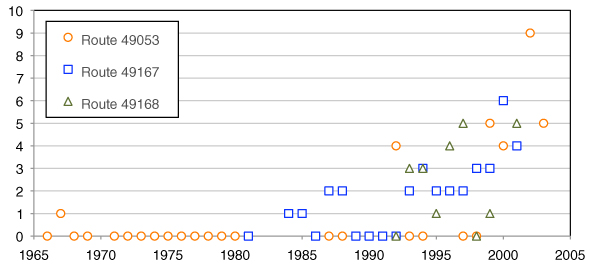
Eastern Bluebird BBS Data
BBS Data: Eastern Bluebirds for Three Michigan Routes (adapted from North American Breeding Bird Survey website)

Route 49053 is of particular interest for a couple reasons. First of all, it is the only one of the three for which data going back to the BBS’s inception is available, allowing the best long-term perspective. Secondly, the increase in Eastern Bluebird abundance corresponds almost perfectly to publication of The Atlas of Breeding Birds of Michigan. Between 1991 and 2000 (the year Lepczyk was conducting his research), the picture changed considerably.

The other two routes—to a lesser degree, certainly—also exhibit notable increases. Why Lepczyk referred to the Atlas rather than to this more recent data is unclear.

Bird Counts
It’s important to recognize that bird counts are not intended to quantify, in any absolute sense, the number of birds in a particular area, a point made clear on the BBS website:

“The survey produces an index of relative abundance rather than a complete count of breeding bird populations.”

In addition, the use of roadside surveys has been criticized for its potential biases. Roadside habitats may not reflect—and/or may change at rates different from—an area’s overall habitat, for example. [3] Also, a number of factors affect an observer’s ability to detect or identify a particular species. Some—sight, hearing, and training, and even clothing color, for example—are associated with the surveyors, while others (e.g., plumage, body size, coloration, and density) have to do with the birds being surveyed. [4] Rosenstock et al. suggest that such impediments raise serious questions about index counts in general:

“Measures of relative abundance derived from index counts… represent an uncertain, confounded combination of detectability and density. Given these weaknesses, index counts should not be expected to provide reliable information or a valid basis for inference.” [4]

All of which makes weighing the six Eastern Bluebirds in Lepczyk’s study against those detected along the survey routes a dodgy proposition. (Dodgier still is the more expansive claim made by Longcore et al. that Lepczyk’s work is “evidence indicat[ing] that cats can play an important role in fluctuations of bird populations.” [5])

House Sparrows
To reiterate, I’m not discounting conservation concerns for rare or protected species (the Eastern Bluebird, it should be noted—and Lepczyk et al. acknowledge—is neither “extremely rare” nor a “species of state or national concern.” [1]) I’m merely pointing out some of the complexities involved in trying to connect predation levels of one species to population levels of another.

Which brings me back to The Atlas of Breeding Birds of Michigan, where I discovered an interesting twist in this story. The Eastern Bluebird, it seems, probably peaked in Michigan during the late 1800s.

“A gradual decline occurred in the early 1900s as the House Sparrow advanced, and favorite nesting places such as wooden fenceposts and old apple orchards were eliminated.” [2]

As it turns out, House Sparrows were at the top of the list in Lepczyk’s study, making up 38% of the identified species of birds taken by cats.

“Although the species group of Sparrows could not be broken down into species, it is very likely that the dominant species observed was the House Sparrow (Passer domesitcus). Sparrows were also the most commonly observed depredated species found in England and Australia [6, 7].” [1]

While I’m not prepared to suggest that the cats’ heavy predation of House Sparrows is responsible for the increasing numbers of Eastern Bluebirds, perhaps it’s not as far-fetched as it sounds. Similar assertions have been made regarding the role of cats in the larger ecosystem (though such claims are rarely in defense of the cats).

Nature’s interconnectedness rarely makes for punchy sound bites or bumper sticker aphorisms. Then, too, such complex relationships are often overlooked, ignored, or dismissed simply because they don’t fit cleanly into one’s argument.

Literature Cited
1. Lepczyk, C.A., Mertig, A.G., and Liu, J., “Landowners and cat predation across rural-to-urban landscapes.” Biological Conservation. 2003. 115(2): p. 191-201.

2. Brewer, R., McPeek, G.A., and Adams, R.J., The atlas of breeding birds of Michigan. 1991, East Lansing, MI: Michigan State University Press.

3. Keller, C.M.E. and Scallan, J.T., “Potential Roadside Biases Due to Habitat Changes along Breeding Bird Survey Routes.” The Condor. 1999. 101(1): p. 50-57.

4. Rosenstock, S.S., et al., “Landbird Counting Techniques: Current Practices and an Alternative.” The Auk. 2002. 119(1): p. 46-53.

5. Longcore, T., Rich, C., and Sullivan, L.M., “Critical Assessment of Claims Regarding Management of Feral Cats by Trap–Neuter–Return.” Conservation Biology. 2009. 23(4): p. 887–894.

6. Churcher, P.B. and Lawton, J.H., “Predation by domestic cats in an English village.” Journal of Zoology. 1987. 212(3): p. 439-455.

7. Barratt, D.G., “Predation by House Cats, Felis catus (L.), in Canberra, Australia. I. Prey Composition and Preference.” Wildlife Research. 1997. 24(3): p. 263–277.

Socialization

One of the greatest advantages of online content is the ability to easily share that content with others, a digital-era grassroots tool of particular importance for issues as contentious and under-reported as the “cat debate.” So, beginning with today’s post, it’s easier than ever to spread the word about Vox Felina. Using the toolbar at the bottom of each post, you can share my analysis and commentary via your favorite social media outlets (e.g., Facebook, Twitter, StumbleUpon, etc.).

I’ve also created a Facebook page where, in addition to re-posting Vox Felina content, I’ll be commenting on news stories from various other sources (e.g., newspapers, blogs, etc.). I encourage readers to join in the discussion. If you like what you see, please “Like” the Vox Felina page, and invite your friends, family, and colleagues to do the same.

False Confessions

Whether the latest iteration of reality TV— Animal Planet’s Confessions: Animal Hoarding—is more education, entertainment, or exploitation is a matter of debate. But it’s a safe bet that by streaming “an unflinchingly honest look at a human condition that affects people and animals” into living rooms across the country, a problem too rarely acknowledged (not to mention taken seriously) is now receiving unprecedented attention.

Even if I were a cable subscriber, though, I don’t think I’d be tuning in. Although I was nowhere near the “front lines” of the Great Kitty Rescue, I’ve seen and heard plenty where animal hoarding is concerned. But in reading about Confessions, I was reminded of some remarks included in a comment published earlier this year in Conservation Biology. There, Christopher Lepczyk, Nico Dauphiné, David M. Bird, Sheila Conant, Robert J. Cooper, David C. Duffy, Pamela Jo Hatley, Peter P. Marra, Elizabeth Stone, and Stanley A. Temple compared TNR to animal hoarding:

“The animal welfare community opposes ‘cat hoarding,’ whereby people care for more pets than they can adequately support, because it is considered inhumane. Trap-neuter-return is essentially cat hoarding without walls. Considering that most communities have laws banning animal hoarding, we should consider the same standard for outdoor cats as those that are in a person’s home.” [1]

This strikes me as almost desperate—the latest volley in the kitchen-sink/something-for-everybody approach taken by some TNR opponents. Nevertheless, the analogy—however incongruous—is not new. In 2004, David Jessup made essentially the same comparison:

“Some people are compelled to own and care for excessive numbers of cats. This psychological illness is referred to as ‘collectors psychosis.’ How is the person who must save 25 to 30 cats in their home different from the person who sees themselves [sic] as the savior of 25 to 30 cats in a park? Some ‘cat people’ may be ‘collectors,’ and it is possible that TNR is enabling and supporting some people who need psychologic counseling and assistance.” [2]

Jessup doesn’t burden himself or his audience with even the slightest support for his assertions; his claims are as much conjecture as anything else, his question largely rhetorical. Five years later, Dauphiné and Cooper revisited Jessup’s query, but—despite a handful of references—do no better in terms of its resolution:

“In many cases, the characteristics and behavior of people involved in TNR are suggestive of the psychiatric disorders described in problematic animal hoarding [3]. When presented with alternatives to TNR, such as enclosed sanctuaries, no-kill shelters, and traditional animal control, many such people can be “fiercely protective, retaliatory, and uncooperative,” [4] and will subject public officials and other citizens opposing TNR to harassment and threats [5, 6].” [7]

Animal Hoarding
Dauphiné and Cooper’s argument presupposes that enough is known both about “people involved in TNR” and “the psychiatric disorders described in problematic animal hoarding” for a valid comparison to be made. In fact, very little is known about either one. Randy Frost, whose 2000 article the authors cite, begins by noting, “almost no psychiatric literature exists on this topic.” [3] A year earlier, Gary Patronek (a collaborator of Frost’s, whose work Frost cites throughout his paper) observed: “Unlike the hoarding of inanimate objects, which may be linked with a variety of psychiatric conditions, animal hoarding has not yet been linked with any specific disorder.” [8]

Nevertheless, both Patronek and Frost describe—based on some of the earliest research on the subject—some common characteristics of, and explanatory models for animal hoarding. And provide this definition:

“someone who accumulates a large number of animals; fails to provide minimal standards of nutrition, sanitation and veterinary care; and fails to act on the deteriorating condition of the animals (including disease, starvation and even death) or the environment (severe overcrowding, extremely unsanitary conditions), or the negative effect of the collection on their own health and well-being and on that of other household members.” [8]

This seems to have been the framework for the definition adopted by the Hoarding of Animals Research Consortium (with which Patronek and Frost were involved), which places greater emphasis on two key elements: denial, and accumulation and control:

  • Having more than the typical number of companion animals;
  • Failing to provide even minimal standards of nutrition, sanitation, shelter, and veterinary care, with this neglect often resulting in illness and death from starvation, spread of infectious disease, and untreated injury or medical condition;
  • Denial of the inability to provide this minimum care and the impact of that failure on the animals, the household, and human occupants of the dwelling;
  • Persistence, despite this failure, in accumulating and controlling animals.

“Saving” 25 or 30 cats, then—whether in one’s home or in the park—does not constitute animal hoarding. As Patronek pointed out during a recent interview on NPR’s Radio Times, “numbers alone don’t define hoarding… you’ve got to have these functional deficits and denial, in combination with the numbers.”

Opponents of TNR (and of free-roaming cats in general) will likely seize upon that second point, arguing that feral cat colonies—by definition—lack adequate care. But the very fact that these cats are part of a TNR program means they’ve been evaluated by veterinary professionals, requiring a concerted effort—sometimes bordering on the heroic—on the part of the trappers and caregivers involved. Some programs perform vaccinations (that this is not standard practice, is, admittedly, a controversial issue); at a minimum, cats deemed too sick to be returned are euthanized.

A 1999 survey of survey of “101 individuals or couples who cared for 132 colonies of free-roaming cats in north central Florida” illustrates the importance caregivers place on health:

“More than a third of the caretakers reported that they had provided some kind of veterinary care (not including being neutered at the TNR clinic) for the cats in the past or would provide veterinary care if it was necessary in the future. This type of care included booster vaccinations, parasite control, antibiotic treatment, ear medication, veterinary examinations, and emergency treatment.” [9]

In addition, 96% provided food, and 75% provided shelter. It’s important to note, too, that these numbers are conservative relative to the care received by the cats, in that (1) some caregivers were responsible for multiple cats, and (2) respondents to the survey were not necessarily the individuals who provided food, shelter, and so forth.

Such findings are certainly consistent with my own experience. The TNR networks I’m tapped into (mostly by way of e-mail or online bulletin boards) are typically buzzing with requests from, and recommendations to, caregivers committed to maintaining and improving the health of feral cat colonies.

On the other hand, it’s not clear from Dauphiné and Cooper’s paper that their reference to animal hoarding has anything to do with the behavior’s defining characteristics at all. More than anything else, the authors seem to be suggesting that resistance to TNR “alternatives” constitutes some psychiatric disorder—a possible reference to animal hoarders’ “reluctance to remove any animals, even when adequate homes were available.” [3]

Alternatives to TNR
Respectable sanctuaries, as I’ve already discussed, are few and far between, and typically at operating at capacity. In any case, such environments are not in the best interest of unsocialized cats. No-kill shelters, too, are scarce, and—recognizing realities Dauphiné and Cooper (and veterinarian Christine Storts, whose letter they cite) overlook or ignore—generally endorse TNR as their feral cat management approach. [10]

And as for “traditional animal control,” that’s nothing more than a rather cowardly euphemism for trap-and-kill.

What about the harassment and threats? Here, Dauphiné and Cooper cite Paul Barrows’ 2004 article “Professional, Ethical, and Legal Dilemmas of Trap-Neuter-Release,” and Pamela Jo Hatley’s 2004 paper, “Will Feral Cats Silence Spring in Your Town?” “During the past several years,” writes Barrows:

“as debate regarding abandoned and feral cats has become more heated, concerns have emerged regarding the extent to which some activists will go to promote their cause. Those supporting trap and removal of abandoned and feral cats, rather than TNR, have reported verbal abuse, personal threats, disruption of public forums, and interference with the conduction of their businesses.” [5]

Dauphiné and Cooper buy into Barrows’ account without bothering to check out his source (actually, these two make a shameful habit of such shortcuts throughout their paper, thereby raising questions about their numerous assertions, and, more problematically, their capabilities and integrity as researchers). In fact, Barrows cites a 2002 Wall Street Journal story in which exactly one of “those supporting trap and removal”—Frank Spiecker, of Garden State Pest Management—was interviewed:

“…property managers, fearing health complaints or lawsuits, hire Mr. Spiecker to trap and remove stray cats… Cat jobs have gotten him screamed at, threatened and jostled. His truck has been jumped on and pounded, his traps run over, and his trapped cats freed… To cat lovers, he abets feline mass murder, since most of the cats he traps end up dead.” [11]

All of which seems remarkably flimsy for describing and condemning—as Dauphiné and Cooper do—the behaviors of “many such people.” Until it’s compared to the even flimsier “evidence” provided by Hatley:

“Many citizens and public officials have voiced concerns about the public health issues and wildlife issues involved in hoarding large numbers of cats in the wild. Some who have resisted the extreme efforts by proponents of TNR and cat colonies have been subjected to verbal abuse and threats.” [6]

Dodgy research practices aside, the notion that one’s preference for TNR over “enclosed sanctuaries, no-kill shelters, and traditional animal control” is indicative of some psychiatric disorder remains a mighty hard sell. Dauphiné and Cooper’s so-called alternatives are simply not—in a very literal sense—viable options.

*     *     *

To compare TNR to animal hoarding betrays either a profound lack of knowledge about either one, or a desperate attempt to taint the former by association with the latter. I suspect that, like the most despicable political strategists, Jessup, Dauphiné and Cooper, and Lepczyk et al., threw it out there just to see if it would stick—the connection they’re attempting to make certainly has nothing to do with science.

I’ve a friend who jokes that the only thing feral cats aren’t being blamed for these days is climate change. Well, not yet, anyhow.

Literature Cited
1. Lepczyk, C.A., et al., “What Conservation Biologists Can Do to Counter Trap-Neuter-Return: Response to Longcore et al.” Conservation Biology. 2010. 24(2): p. 627-629.

2. Jessup, D.A., “The welfare of feral cats and wildlife.” Journal of the American Veterinary Medical Association. 2004. 225(9): p. 1377-1383.

3. Frost, R., “People Who Hoard Animals.” Psychiatric Times. 2000. 17(4).

4. Storts, C.M., “Discussion on TNR programs continue (letter).” Journal of the American Veterinary Medical Association. 2003. 222: p. 711–712.

5. Barrows, P.L., “Professional, ethical, and legal dilemmas of trap-neuter-release.” Journal of the American Veterinary Medical Association. 2004. 225(9): p. 1365-1369.

6. Hatley, P.J. (2004) Will Feral Cats Silence Spring in Your Town? www.pamelajohatley.com/Articles/ABA.pdf Accessed August 8, 2010.

7. Dauphiné, N. and Cooper, R.J., Impacts of Free-ranging Domestic Cats (Felis catus) on birds in the United States: A review of recent research with conservation and management recommendations, in Fourth International Partners in Flight Conference: Tundra to Tropics. 2009. p. 205–219.

8. Patronek, G.J., “Hoarding of animals: An under-recognized public health problem in a difficult-to-study population.” Public Health Reports. 1999. 114(1): p. 81–87.

9. Centonze, L.A. and Levy, J.K., “Characteristics of free-roaming cats and their caretakers.” Journal of the American Veterinary Medical Association. 2002. 220(11): p. 1627-1633.

10. Winograd, N.J., Redemption: The myth of pet overpopulation and the no kill revolution in America. 2007: Almaden Books.

11. Sterba, J.P., Tooth and Claw: Kill Kitty?, in Wall Street Journal. 2002: New York. p. A.1

Repeat After Me

Listening to NPR’s On the Media this weekend, I was struck by a story (first broadcast in 2006) about how certain “sticky” numbers—however dubious—find their way into the media landscape and beyond, as On the Media co-host Brooke Gladstone noted:

“Four years ago, we delved into the mysterious number, said to be 50,000, of child predators online at any given time. It was cited by the NBC Dateline program “To Catch a Predator” and also by then Attorney General Alberto Gonzales.

But spokespersons for the FBI, the National Center for Missing and Exploited Children, and the Crimes against Children Research Center said it was not based on any research they were aware of. The A.G.’s office at the time, well, they said it came from Dateline.”

Wall Street Journal columnist Carl Bialik, who spoke to Gladstone for the story, described the process whereby such slippery figures gain traction:

“An interesting phenomenon of these numbers is that they’ll often be cited to an agency or some government body, and then a study will pick it up, and then the press will repeat it from that study. And then once it appears in the press, public officials will repeat it again, and now it’s become an official number.”

All of which sounds very familiar—Bialik could easily be describing the “official numbers” put out by so many TNR opponents. Among those that have gained the most currency are the predation estimates from the Wisconsin Study, the American Bird Conservancy’s figure for the proportion of birds in the diets of free-roaming cats, and Dauphiné and Cooper’s estimate of free-roaming cats in the U.S.

The Wisconsin Study
Despite its having been discredited long ago (see, for example, “Addressing the Wisconsin Study”), the Wisconsin Study continues to be cited as if its estimate of 8–219 million birds killed by the state’s rural cats [1] was credible. As recently as last year, Longcore et al. cited the work in their essay “Critical Assessment of Claims Regarding Management of Feral Cats by Trap–Neuter–Return.” [2]

This, despite the fact that—15 years earlier—co-author Stanley Temple told the press:

“The media has had a field day with this since we started. Those figures were from our proposal. They aren’t actual data; that was just our projection to show how bad it might be.” [3]

It’s true: the media has had a field day. Among the major newspapers to cite the Wisconsin Study are the Wall Street Journal [4], the New York Times [5], and the Los Angeles Times [6]. However, as I’ve described previously, it’s been the wildlife conservationists and bird advocates who’ve really had a field day with the Wisconsin Study:

  • The American Bird Conservancy (ABC) refers to the study, in its brochure Domestic Cat Predation on Birds and Other Wildlife. And the ABC goes one step further, pointing out that Coleman and Temple’s estimate was for rural cats, and that “suburban and urban cats add to that toll.” [7]
  • A 2009 article in Audubon Magazine suggests “cats were annually knocking off somewhere in the neighborhood of 8 million birds just in rural Wisconsin.” [9] To the magazine’s credit, they used Coleman and Temple’s low estimate—but none of the numbers from the Wisconsin Study are scientifically sound.

Birds Represent 20–30% of the Diet of Free-roaming Cats
According to an ABC report (downloadable from their website), “extensive studies of the feeding habits of domestic, free-roaming cats… show that approximately… 20 to 30 percent [of their diet] are birds.”

This, apparently, is the same report that Ellen Perry Berkeley debunked in her book, TNR Past Present and Future: A history of the trap-neuter-return movement, noting that the ABC’s 20–30% figure was not based on “extensive studies” at all. [10] In fact, just three sources were used: the now-classic “English Village” study by Churcher and Lawton [11], the Wisconsin Study (described above), and Mike Fitzgerald’s contribution to “The Domestic Cat: The Biology of Its Behaviour.” [12]

This gets a little complicated, so bear with me.

When Churcher and Lawton reported, “overall, birds comprised 35% of the total catch,” [11] they were referring to prey tallies recorded by study participants—not to the overall diets of the cats involved. Figures obtained through similar methods for the Wisconsin Study were 20–23%, [1, 13, 14] which the authors suggest—citing Fitzgerald’s comprehensive review of predation and dietary studies—are in line with other work:

“Extensive studies of the feeding habits of free-ranging domestic cats over 50 years and four continents [12] indicate that small mammals make up approximately 70% of these cats’ prey while birds make up about 20%.” [14]

But they’re comparing apples and oranges. Both the English Village and Wisconsin Studies report the percentage of birds returned as a portion of the “total catch,” whereas Fitzgerald reports percentage by frequency (i.e., the occurrence of birds in the stomach contents or scats of free-roaming cats), a point apparently lost on Coleman and Craven. The 21% figure [12] they refer to, then, is simply not comparable to their own (or that of the English Village study, a fact Churcher and Lawton acknowledge in their paper). As Berkeley notes, “this would put birds, as a portion of the diet of cats, at roughly 7 to 10.5 percent—nowhere near the ‘20 to 30 percent’ figures unleashed on the unscientific public by ABC!”

To put all of this into more familiar terms, it’s a bit like saying that coffee makes up 20–30% of the American diet versus saying that 20–30% of Americans drink coffee each day.

Nevertheless, 13 years after the ABC first published its report, the myth persists. The report—including the mistaken dietary figures—is still available. And the National Audubon Society has helped perpetuate the error, noting in its Resolution Regarding Control and Management of Feral and Free-Ranging Domestic Cats:

“…it has been estimated that birds represent 20–30% of the prey of feral and free-ranging domestic cats.”

Estimates of Free-roaming Cats
In January, Steve Holmer, the ABC’s Senior Policy Advisor, told the Los Angeles Times, “The latest estimates are that there are about . . . 160 million feral cats [nationwide].” Sounds like an awful lot of cats—nearly one for every two humans in the country. So where does this figure come from?

The source is a paper by Nico Dauphiné and Robert Cooper (which can be downloaded via the ABC website), presented at the Fourth International Partners in Flight conference. In it, Dauphiné and Cooper use some remarkably creative accounting, beginning with an unsubstantiated estimate of unowned cats, to which they add an inflated number of owned cats that spend time outdoors. In the end, they conclude that there are “117–157 million free-ranging cats in the United States.” [15] (For a more thorough explanation, see my previous post on the subject.)

Estimating the number of free-roaming cats wasn’t even the point of their paper. As the title—“Impacts of Free-ranging Domestic Cats (Felis catus) On Birds In the United States: A Review of Recent Research with Conservation and Management Recommendations”—suggests, the primary purpose was to describe the cats’ impact on birds. The authors’ exaggerated figure was merely a convenient route to their estimate of birds killed annually by cats: “a minimum of one billion birds” [15] (which, it should be clear, has the potential to become a very sticky number).

Holmer goes a step further, using only the upper limit of the range published by Dauphiné and Cooper, and making the subtle—but important—shift from free-ranging to feral cats.

When I asked him about this, he explained that those figures were “based on an earlier version of Nico’s latest paper and are now being updated in our materials.” I don’t know that any such changes were made; and in any event, the bogus estimate has already been published in the L.A. Times—as if it were true.

*     *     *

TNR opponents will often point to the vast collection of research studies, government reports, news accounts, and the like, that support their assertions. Drill down a bit into that collection, though, and they all start to look alike: the same familiar sources, the same flawed studies—and the same bogus figures. These figures have become the kind of “official numbers” Bialik refers to: quantitative poseurs owing their popularity to tireless—and irresponsible—repetition more than anything else.

Literature Cited
1. Coleman, J.S. and Temple, S.A., On the Prowl, in Wisconsin Natural Resources. 1996, Wisconsin Department of Natural Resources: Madison, WI. p. 4–8. http://dnr.wi.gov/wnrmag/html/stories/1996/dec96/cats.htm

2. Longcore, T., Rich, C., and Sullivan, L.M., “Critical Assessment of Claims Regarding Management of Feral Cats by Trap–Neuter–Return.” Conservation Biology. 2009. 23(4): p. 887–894.

3. Elliott, J., The Accused, in The Sonoma County Independent. 1994. p. 1, 10.

4. Sterba, J.P., Tooth and Claw: Kill Kitty?, in Wall Street Journal. 2002: New York. p. A.1

5. Barcott, B., Kill the Cat That Kills the Bird?, in New York Times. 2007: New York. http://www.nytimes.com/2007/12/02/magazine/02cats-v–birds-t.html

6. Kennedy, J.M., Killer Among Us, in Los Angeles Times. 2003: Los Angeles. http://articles.latimes.com/2003/dec/23/news/os-cat23

7. ABC, Domestic Cat Predation on Birds and Other Wildlife. n.d., American Bird Conservancy: The Plains, VA. www.abcbirds.org/abcprograms/policy/cats/materials/predation.pdf

8. FWS, Migratory Bird Mortality. 2002, U.S. Fish and Wildlife Service: Arlington, VA. www.fws.gov/birds/mortality-fact-sheet.pdf

9. Williams, T., Felines Fatale, in Audubon Magazine. 2009, National Audubon Society: New York, NY. http://www.audubonmagazine.org/incite/incite0909.html

10. Berkeley, E.P., TNR Past present and future: A history of the trap-neuter-return movement. 2004, Bethesda, MD: Alley Cat Allies.

11. Churcher, P.B. and Lawton, J.H., “Predation by domestic cats in an English village.” Journal of Zoology. 1987. 212(3): p. 439-455.

12. Fitzgerald, B.M., Diet of domestic cats and their impact on prey populations, in The Domestic cat: The biology of its behaviour, D.C. Turner and P.P.G. Bateson, Editors. 1988, Cambridge University Press: Cambridge; New York. p. 123–147.

13. Coleman, J.S. and Temple, S.A., Effects of Free-Ranging Cats on Wildlife: A Progress Report, in Fourth Eastern Wildlife Damaage Control Conference. 1989: University of Nebraska—Lincoln. p. 8–12. http://digitalcommons.unl.edu/ewdcc4/7

14. Coleman, J.S., Temple, S.A., and Craven, S.R., Cats and Wildlife: A Conservation Dilemma. 1997, University of Wisconsin, Wildlife Extension. http://forestandwildlifeecology.wisc.edu/wl_extension/catfly3.htm

15. Dauphiné, N. and Cooper, R.J., Impacts of Free-ranging Domestic Cats (Felis catus) on birds in the United States: A review of recent research with conservation and management recommendations, in Fourth International Partners in Flight Conference: Tundra to Tropics. 2009. p. 205–219.